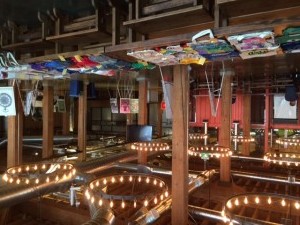
50×50 at The National Archives

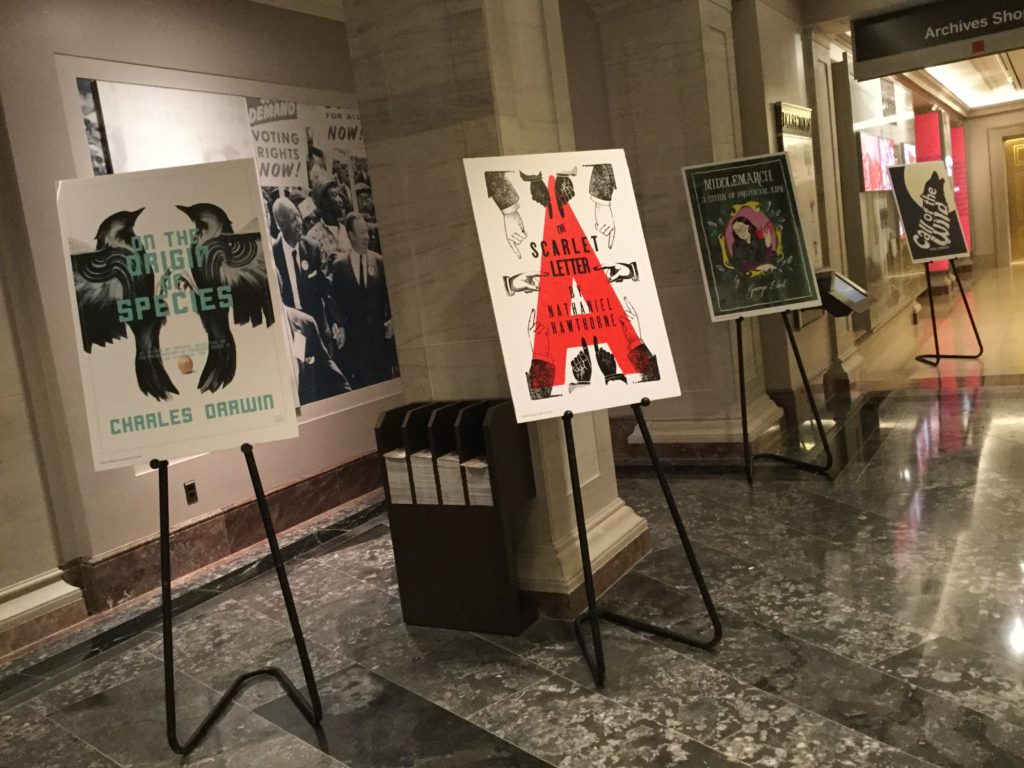
Recovering the Classics had a 50×50 exhibit at its most prominent location yet: The National Archives, as part of DPLAfest.

The piece, “Space Raft Time Ship,” was created by Anthony Johnson, a Navajo artist who traveled in from Phoenix to execute the pieces.


Anthony managed to design, construct, install and perform his piece in 72 hours after he landed.

The artist says, “My main concern was to honor all the beautiful book covers. Artists from all around the world are participating in this amazing project, so I wanted their work to be the focus, but I also wanted to make a statement about storytelling and highlight some little known facts about the founding of our nation. So I channeled one of my favorite books, The Adventures of Huckleberry Finn (hence the raft) and decided to make the piece about our collective life experience through storytelling. So that’s how the name works. We’re all on this incredible space raft called Earth, moving through time, and the stories we write, our histories, our heritage…these are the things that allow us to evolve our consciousness. They shape our experience in Space and enhance being alive.”

To give emphasis to the book covers, Anthony wove paper covers printed in 12 foot sections through metal grates to create a rug-like patten. He also attached them to pieces of rope knotted in deliberate intervals. He says both weaving and knotting are methods that Indigenous People use to tell stories and keep history.

“I’m Navajo and my people are known for weaving. Some rugs have even been sold for a million dollars. But a lot of people don’t know these rugs are like books for us. They contain stories and knowledge that is passed on orally from generation to generation, just like a book can be. With the knotted rope, I wanted to show that many Indigenous People had intricate documentation systems. In fact, the Incan People used a system of knot tying called Quipu to keep history. People in that society were trained specially to create and interpret that system. This is just like how we use the written word to communicate today. And that’s why the smaller book covers are attached to knotted pieces of rope.”

Because the work was displayed in the National Archives, he wanted to reference documentation systems other than the written word. This is in spirit with Recovering the Classics because we are using visual imagery to reinvigorate interest in classic books.

Lastly, the wooden structure was created to showcase the book covers and give a raft-like feel. Not only was this practical to hang the rope from, it is also a deeply significant representation for the artist himself.

As Anthony describes in his own words:

When you get the opportunity to show something in the same building as the US Constitution, it better have some meaning. Some people might look at the wooden structure as some pieces of wood tied together, but it is actually a representation of the many types of lodges and shelters we Indigenous Peoples use to tell stories and govern ourselves. The tripod structure is reminiscent of the tipis Plains People use in their life way as both shelters and ceremonial houses. Additionally, the three poles also represent the three branches of our American government and that we are all connected to the Earth, the Ultimate governance system.

The pole structure is also symbolic of the lodges our people build to dance and hold ceremony in. A lot of people don’t know that Benjamin Franklin frequented the villages of the Iroquois Confederacy and Algonquin people around the Northeast United States, documenting his thoughts in an essay called “Remarks Concerning the Savages of North America.

He extracted many of their practices and shared them with the Founding Fathers while they sought to make a government that was more harmonious. That’s why everyone in Congress has the opportunity to speak. That’s why they sit in a circle. He got these and many other concepts from the Indigenous people in his area. The other part of these lodges that is important is the fire. That’s why in the piece, each tripod has a pile of cards below it. They represent fire. It’s something we use in all our ceremonies, in all our homes. We talk around fire, tell stories. We warm ourselves. We cook. We read books. There’s something primal and essential about it.”

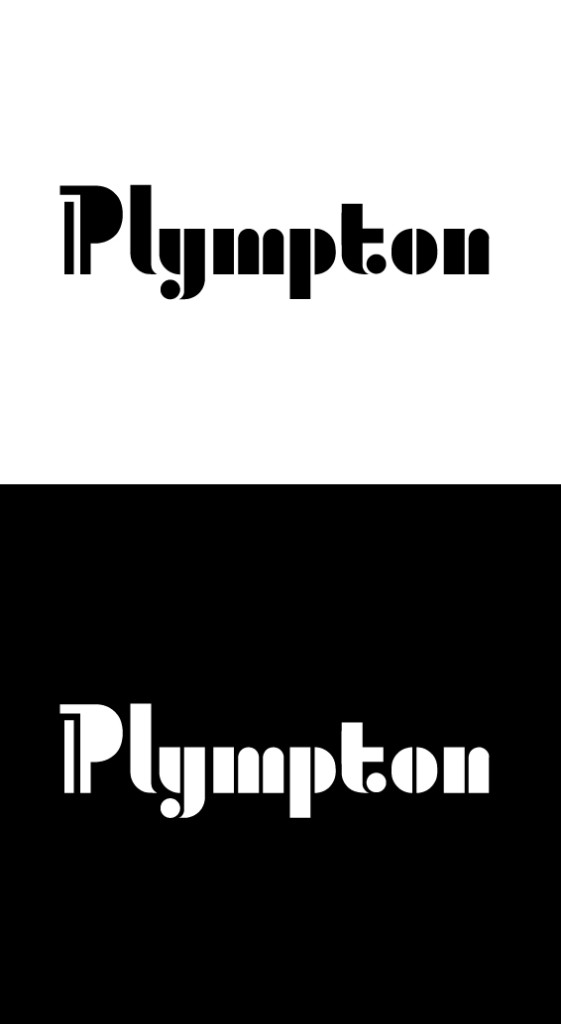
Yiying Lu’s New Plympton Logo

The fabulous artist Yiying Lu has given Plympton a facelift and designed a bold new wordmark. Yiying’s clients have included Disney, Twitter, Scholastic, and even Conan O’Brien. So we are thrilled she took the time to design the Plympton logo. (The fact that she collaborated on the Dumpling Emoji with Plympton co-founder Jennifer 8. Lee may have helped).


Yiying’s new Plympton logos

Yiying’s new Plympton logos


Salient examples of Yiying’s work include the beloved “Fail Whale”, the erstwhile logo of Twitter service outages which helped her gain worldwide fame. More recently she redesigned that whale for Conan O’Brien’s website.

Her eclectic style is informed by work in many different visual mediums including web design, illustration, origami, dolls, and packaging.

Yiying’s work is typified by vibrant colors and joyous characters, often animals. But she also is equally experienced in corporate branding and delivering to companies styles that fit their needs. Her design for Plympton is an understated departure from her harlequin mode. It opts for a striking stencil look that evokes a classic printer’s ink style.

The Plympton  “P” is a take on the paragraph or pilcrowsymbol.

You can see more of Yiying’s work on her website

Bring Recovering the Classics to Your Community: The 50×50 Campaign

We were so blown away by the response to Recovering the Classics at ALA 2015 that we have big news:

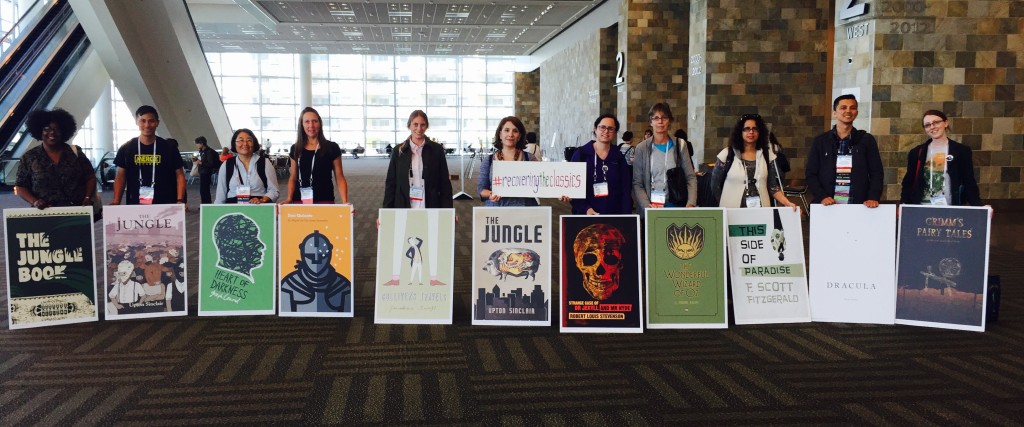
We’re bringing the covers to all 50 states, and we need your help! We’re calling the campaign 50×50. The idea is to build a community of book-lovers across the country by exhibiting at least 50 covers in libraries, book festivals, galleries, schools, and other places of your imagination in all 50 states. 

You can become involved by volunteering to organize an event of your own! We’re already getting started with some great folks in North Carolina, Massachusetts, Illinois, Ohio and other states. And we’re planning a Kickstarter in the fall to help bring down the costs for exhibitors.


Below is our official announcement:

Recovering the Classics Presents 50×50

Celebrate the success of Recovering the Classics by hosting your own 50×50 event! With your help, we can showcase 50 classic book covers in all 50 states, and nurture communities of book-lovers in the process.

In 2013, Recovering the Classics asked designers from around the world to reimagine covers for great books in the public domain. This spring, we announced a partnership with the New York Public Librarythe White House and the Digital Public Library of America to bring the covers to libraries and schools nationwide through special edition ebooks.

Now it’s time to celebrate! We’re looking for libraries, schools, book stores, galleries, local civic organizations, and others across the country to create their own events around the covers — exhibits, readings, school activities, or design-a-thons.

By coming together for this series of events, we’ll develop a community of readers who will share ideas, events and curricula around these classics for years to come.

Host Your Own

Do you want to hold your own local Recovering the Classics exhibit? We have posters in different sizes, as well as postcards and stickers. Right now, we are working on bringing down these costs for partners, which is where our future Kickstarter and sponsorships comes in.

To really do it right, you would pair our covers with designs by your local artists, giving everything a distinct regional flair.

If no single local organization can exhibit 50 covers, we can send batches of 10 or 25 to multiple groups within a state. We’re happy as long as there are at least 50 distinct covers in each of the 50 states!

Ideating with Stanford d.school at CODEX Hackathon

So we had all these amazing people coming to CODEX — passionate people from around the country with a great mix of backgrounds: engineers, designers, literary journal editors and librarians. But how exactly do you get them working together to tackle the challenges of reading, publishing, libraries?

Some people came in with a team, or a project already in mind. But what about all the others?

We were superlucky to connect with Erik Olesund, who teaches at the Institute of Design at Stanford (also known as the Stanford d.school). He volunteered to start our hackathon by holding a design thinking and innovation workshop. Whew.

First, he gave us a very specific shopping list:

  • 25 packs of 3×3 inches Post-It notes
  • 50 black Sharpies
  • 5 packs of large 8×6 Post-It notes.

Total bill: $77.45

Erik Olesund from Institute of Design at Stanford | Photo by Michael Bucuzzo.

Erik Olesund from Institute of Design at Stanford | Photo by Michael Bucuzzo.

Some of our folks from the literary world were a bit nervous about coming to a hackathon, since they weren’t programmers and had never “hacked” before. Did they have to prepare? We assured them that their perspectives were actually critical to making great projects.

A successful hackathon is often less about the technical expertise coming in, and more the ideation and collaboration, Olesund had explained to us. In the design process, Olesund said there are two main components in helping great ideas flourish.

A diverse set of expertise is actually a group’s advantage, said Olesund, as people specialized in different skillsets are working together to come up with the best solution (check! CODEX had that, by using travel stipends to curate the crowd).

“A developer and a publisher see the world through very different lenses,” he said. “So having someone who is very different from you look at a problem that you care about is something extremely helpful.” Another component is to have a very open mind to ideas. “So even though you might have like 50 years of experience…right now you’re going to say yes to let all the ideas to allow people to be really creative and generative,” Olesund said.

During the 45-minute session, any awkward getting-to-know-one-another feeling quickly dissipated as the room began bustling with people actively engaging with one another. One of the key exercises Olesund did was pairing people off, and then having them shoot down each other’s ideas, followed by a session where they built off their ideas, no matter how crazy. The results — and energy levels — were incredibly different. It was a subtle lesson that helped set the tone for the weekend.As a result, the brainstorming session helped folks generate hundreds of ideas.

Adina Talve-Goodman, the managing editor at One Story, found the entire design workshop inspiring, and familiar. “I recognized a lot of the techniques and exercises used during the Stanford design process from when I used to do improv and theater,” said Talve-Goodman. Her group, which included a systems designer from IDEO, ended up creating Close Reader, a platform that allows writers to workshop remotely with each other.

Colorful Post-it notes containing ideas of all capacities quickly found its way up on the walls. From there, hackers with similar ideas congregated together. These new-formed groups then had the opportunity to select the best ideas, refine them and move forward with them.


Group brainstorming ideas | photo by Michael Bucuzzo.

Group brainstorming ideas | photo by Michael Bucuzzo.

“The Stanford design process really helped bring together a lot of interesting ideas and teams,” said Ted Benson, a MIT PhD who is founder at Cloudstitch, who participated in the session. “It was also nice to have that process kick off the hackathon, because when we all demoed our projects the following afternoon, everyone was already familiar with the people and ideas for each team.”

While hacking includes sketching out concepts and creating experiences to test initial assumptions, “hacking is a broadly defined term,” he said.

Here is a list of the projects that came from the hackathon.

For anyone who is curious, the Stanford d.school workshops also come in many versions, including day-long, two-day long and week-long versions for all sorts of organizations and companies.

Our CODEX Hackathon Soirée and Pop-Up Gallery at GitHub Headquarters


To kick off our CODEX Hackathon on Friday evening, we threw a soirée and pop-up gallery at GitHubheadquarters where almost  200 literary, library and tech folk mingled together before getting together the next day to hack.

GitHub’s headquarters is a beautifully decorated warehouse in SoMa, one of the most stunning offices in San Francisco. The first floor resembles a bar more than an office. That night — thanks to work Kathy Jaller, Craig Reyes and Rachel Myers —  we transformed the space into a gallery.

We put dozens of Recovering the Classics covers on easels and dispersed throughout the space. We had live music by singer-songwriter Daniel Park from Las Vegas.

Thanks to publishers and literary goods folks, we had a schwag table filled with T-shirts, totes, socks and pouches from Out of Print and temporary tattoos from Litographs. We had open bar with literary cocktails and a buffet that included yummy dumplings from Shanghai Dumpling King (highly recommended for catered events)


And this being a publishing soiree, of course we had a literary cocktail menu.

  • Tequila Mockingbird: Z Blanco Tequila, Grapefruit Juice, Topo Chico, Salt
  • Catcher in the Rye: Bulleit Rye, Angostura Bitters, Fine White Sugar
  • Vermouth the Bell Tolls: Dry Gin, Sweet Vermouth, Dry Vermouth, Shake, Served Up
  • Margarita Atwood: 3 Caballos Blanco, Cointreau, Fresh Lime Juice, Salt, Served Up

With a lovely menu.


Best of all, Margaret Atwood retweeted the literary cocktail menu!

CODEX Hackathon during ALA in San Francisco in June

We’re throwing a literary/publishing/library/book hackathon in San Francisco called CODEX. during the American Library Association conference on the weekend of June 26-28, 2015.

It’s a gathering of people who want to imagine the future of books and reading! Programmers, designers, writers, librarians, publishers, readers.

You can apply and register via Submittable. Thanks to the generosity of our sponsors, we have travel stipends!

Schedule:

  • Opening reception at Github (who is also a sponsor) on Friday with our Recovering the Classics pop-up gallery.
  • Hackathon Saturday-Sunday at Code for America in SOMA(hard capacity is 120).

The theme/challenge will be “connecting.” So connecting around books, connecting around reading, connecting readers and authors, connecting libraries with books. So imagine dating app for readers, Groupon for books, Tinder for book discovery, new APIs,

Partners and sponsors include New York Public Library, the Knight FoundationStanford d.schoolDropbox, MacMillan, Kickstarter, HarperCollins, Mailchimp, Github, the Digital Public Library of America, Publishers Weekly, Project Gitenberg, Recovering the Classics, Harvard Book Store.

Among the tools being made available: advance access to the Pinterest API, book covers from Recovering the Classics, Gitbook reviews data from Publishers Weekly, folks to help with the Digital Public Library of America API, Trajectory’s Natural Language Processing engine, the BitLit “Shelfie” book OCR API.

It’s going to be epic.

Why CODEX? Because the codex (modern books with spines) allowed for random access of data, as compared to scrolls, which only allow sequential access.


Recovering the Classics partners with the White House, NYPL and DPLA

Our Recovering the Classics project has teamed up with the NYPL, Digital Public Library of America and the White House as part of the Obama Administration’s eBook initiative for low-income kids.

Here is our cameo!

The Digital Public Library of America: Their network of librarians will volunteer with the New York Public Library to help make sure popular books reach the most appropriate audience. DPLA, in conjunction with Recovering the Classics are also add age-appropriate public domain titles whose text and cover art has been redesigned by leading graphic designers and artists

Jennifer 8. Lee, a cofounder, also recently joined the board of the DPLA.

Full text below.

For Immediate Release

April 30, 2015

FACT SHEET: Spreading the Joy of Reading to More Children and Young Adults


Every child deserves the chance to learn and thrive in an environment that is enriched by the latest technology. Two years ago President Obama announced ConnectED, a signature initiative focused on transforming teaching and learning through digital connectivity and content.  Today, building on the progress made to date, at the Anacostia Library in Washington, D.C., the President will announce two new efforts to strengthen learning opportunities by improving access to digital content and to public libraries: new eBooks commitments and the ConnectED Library Challenge.

The first is commitments from publishers to find ways to make sure their content is available to low-income youth in America.  Major publishers are announcing they will make over $250 million in free eBooks available to low-income students.  Nonprofits and libraries are partnering with each other to create an app that can deliver this content and materials from the public domain.  Complementing that effort, the ConnectED Library Challenge is a commitment by more than 30 communities to put a library card into every student’s hand so they will have access to the learning resources and books they can read for pleasure, all available in America’s libraries.

These initiatives represent another way the ConnectED effort is making a real difference for students. Combined with the $2 billion in private-sector commitments, and Federal Communications Commission (FCC) funding for school and library connectivity that includes $2 billion specifically for Wi-Fi, and $1.5 billion more in annual funding — today’s announcement brings the total value delivered as part of this five-year transformation in American education to over $10 billion. And as a result of these commitments, we are on track to meet the President’s goal of connecting 99 percent of students to high-speed broadband in their classrooms and libraries.

—————–

As part of today’s effort, the New York Public Library is developing an e-reader app that will provide access to a universe of digital books, including contributions from publishers and hundreds of classics already in the public domain, to create a book collection for students aged 4-18 from low-income families.  The New York Public Library will work with a network of top librarians will be volunteering their time through the Digital Public Library of America to connect young readers with books that match their reading levels and interests.  New York Public Library will work with Firstbook, a book-donation non-profit, to help make sure eBooks reach students in low-income families.

Major publishers are committing to make available thousands of popular and award-winning titles to students over a three-year period.  These contributions will create a new book collection for students aged 4-18 from low-income families. Students from all demographics will be able to access the public domain titles, whose cover art and typography will be freshly designed by world-class designers and artists.

The new commitments the President will announce today will help ensure the smartphone or tablet that is increasingly a part of students’ lives is also a teaching tool outside the classroom that encourages kids to become lifelong readers.

Hundreds of Millions of Dollars in New Private-Sector Commitments: Today, the President will highlight some of the major publishers and their authors that have pledged to donate titles to low-income students:

  • Macmillan: Providing unlimited access to all of the K-12 age-appropriate titles in their title catalog of approximately 2,500 books.
  • Simon & Schuster: Providing access to their entire e-catalog of books for children ages 4-14, comprised of 3,000 titles.
  • Penguin Random House: Committing to provide an extensive offering of their popular and award-winning books.
  • Hachette: Offering participating students access to a robust catalogue of their popular and award-winning titles.
  • Candlewick: Providing unlimited access to all relevant children’s and young-adult e-book titles in their catalog.
  • Bloomsbury: Providing unlimited access to over 1,000 of its most popular titles.
  • Lee & Low: The leading independent publisher of multicultural books is providing unlimited access to over 700 of its titles.
  • Cricket Media: Offering full digital access to all of its market-leading magazines for children and young adults, including Ladybug and Cricket.
  • HarperCollins: Providing a robust selection of their award-winning and popular titles.

Commitments from Government, Non-profit, and Philanthropic Institutions: Today, the President will highlight commitments supporting expanded access to free books:

  • The Institute of Museum and Library Services: Investing $5 million to support the development of the e-reader app and tools and services to help the public  more easily access e-books and other digital content.
  • The Digital Public Library of America: Their network of librarians will volunteer with the New York Public Library to help make sure popular books reach the most appropriate audience. DPLA, in conjunction with Recovering the Classics are also add age-appropriate public domain titles whose text and cover art has been redesigned by leading graphic designers and artists.
  • New York Public Library: New York Public Library is developing a cutting-edge e-reader app and working with industry and tech leaders to improve the experience for students.
  • FirstBook: a book donation non-profit organization has committed to work with New York Public Library and interested publishes to provide authentication and delivery services to ensure that e-books will reach students in low-income families.

—————————

President Obama recognizes the critical role that libraries play as trusted community anchors that support learning and connectivity at all times and many different paces. In fact, more than 70 percent of libraries report that they are the only providers of free public internet access in their community. Like many modern challenges, improving education for all children requires key leaders to collaborate in new and powerful ways. Libraries are uniquely positioned to continue to build programs and partnerships that bridge the divide between schools and homes and provide educational services to every person in the community.

Announcing the ConnectED Library Challenge: Today, the President will call upon library directors to work with their mayors, school leaders, and school librarians, to create or strengthen partnerships so that every child enrolled in school can receive a library card. These libraries also commit to support student learning through programming that develops their language, reading, and critical thinking; provide digital resources, such as eBooks and online collections of traditional media; and provide broadband connectivity and wireless access within library facilities. Over 30 major cities and counties have announced they are taking the challenge and will work to provide cards to all students.

Communities adopting the ConnectED Library Challenge include: Baltimore, Boston, Charlotte, Chicago, Cleveland, Clinton Macomb, Columbus, Cuyahoga, D.C., Denver, Hartford, Hennepin County, Howard County, Indianapolis, Madison, Milwaukee, New Haven, Oakland, Pierce County, Pima, Pocatello, Pueblo City, Ramsey County, Columbia, Rochester Hills, Rochester, Salt Lake City, San Francisco, Seattle, Skokie, and St. Louis.

Commitments in support of the ConnnectED Library Challenge:To support the implementation of the ConnectED Library Challenge, the Administration announced new commitments to action:

  • The Institute of Museum and Library Services: Host a national convening this summer to identify and share best practices in reaching universal library card use among public school students.
  • Urban Libraries Council: Lead an initiative that provides a forum for community, library and school leaders to work together to meet city and county education goals by leveraging resources and measuring outcomes.
  • American Library Association:  Drive adoption of the ConnectED Library Challenge through their 55,000 members and align the challenge with existing support and technical assistance provided through their Every Child Ready to Read initiative.

We’re in the Best American Short Stories 2014!

We’re excited to announce that four of the stories we published were highlighted in The Best American Short Stories 2014 collection, which was guest edited by Jennifer Egan.

They were:

  • “Chairs in the Rafters” by Julia Glass
  • “Love on Mars” by our own Justin Keenan
  • “ILY” by Tova Mirvis
  • “Seibert” by Adam Haslett

There are 100 notable stories that are first selected by the series editor, Heidi Pitlor, from submissions across the country each year (in print!). Then they are further whittled down by the series editor. So we’re surprised and excited that so many of our stories made it in.

A Pairing for Valentine’s Day: Plympton Joins Forces With DailyLit

We are thrilled to announce at the TOC conference in New York that Plympton is joining forces withDailyLit, the oldest and largest digital distributor of daily serialized fiction. Chosen as the #1 book website by the Sunday Times in London, DailyLit has been delivering great books and series  in short installments directly to readers’ inboxes since 2006. Hundreds of thousands of readers have received over 50 million installments through DailyLit.

This combination of DailyLit’s worldwide distribution platform together with Plympton’s original serial fiction presents a unique and exciting opportunity in cutting-edge publishing. The DailyLit library ranges from classics like Pride and Prejudice and Moby Dick to modern treasures by writers like Jhumpa Lahiri and Margaret Atwood. Our ambition is to commission and add to that library.

DailyLit was founded by Susan Danziger, formerly of Random House, and her husband, Albert Wenger, a partner at Union Square Ventures whose birthday is this week. The initial idea behind DailyLit was to integrate quality reading into people’s busy, daily lives — through “byte-sized ebooks” as The New York Times put it — a notion that is even more pertinent today.


Susan and Albert are now investors and advisors to the combined company, and Plympton will be taking over and expanding DailyLit operations. To oversee the technical aspects of that effort, Jacqueline Chang, an MIT graduate who was mostly recently an engineer at StumbleUpon, has joined us as our technical cofounder and Chief Technology Officer.

As my cofounder, the novelist Yael Goldstein Love, says, “DailyLit has always been about making books a daily part of peoples’ lives again. I’m inspired by it as a writer and a reader and thrilled to have this chance to expand on the great work Susan has already done while also giving our own original fiction a welcoming new home.”

In particular, we’ve been impressed how DailyLit has created an intimate and direct relationship with readers. When Susan sends out the newsletter to hundreds of thousands in the DailyLit audience, people write back personally.

Our vision for the future of DailyLit tackles a number of problems that are facing publishers, authors, and independent bookstores as reading becomes increasingly digitized. Susan and Albert have already created a robust platform for delivering great writing, having launched almost 1,000 critically acclaimed titles from a number of major publishers.

We at Plympton want to bring the DailyLit experience up-to-date by developing new and engaging ways to give readers more power than ever to read what they want, when and where they want.

DailyLit was the first way to get a library of fiction delivered to your phone (“highbrow” as the New York Magazine’s Approval Matrix put it). The first iteration was in 2006, in the ole’ Blackberry and Treo days, pre-Kindle, pre-iPhone. Back then, it was all by email, but today mobile devices like smartphones and tablets are clearly changing the way we read, and we want to re-imagine the entire DailyLit experience. That means everything from commissioning works meant to be read natively in digital format to finding the best way to deliver those stories to readers.

These are issues the whole publishing industry is thinking about, and DailyLit will not only promote Plympton’s original series, but will provide solutions for great serialized titles coming out from other publishing houses, many of whom have made works available on DailyLit in the past.

Over the last several months, our editorial team have been busy commissioning new series for Plympton/DailyLit and have been thrilled to discover how many writers are eager to try their hand at this old-new form of storytelling. Upcoming titles will include original fiction by, among others, Rachel Kadish, author of the critically-acclaimed novels From a Sealed Room and Tolstoy Lied: A Love Story; Deni Bechard, whose debut novel Vandal Love won the 2007 Commonwealth Writers’ Prize; National Book Award Finalist Edith Pearlman; and Julian Gough, whose novel Jude in Ireland was shortlisted for the Bollinger Everyman Wodehouse Prize for Comic Fiction and who has twice been nominated for (and once been awarded) the BBC short story award. We also remain committed as ever to discovering emerging talent and giving a platform to great writing that might otherwise not find a home in an increasingly shrinking marketplace.

We are particularly excited to unveil WinkPoke, an ongoing series of short stories about love in the digital age. WinkPoke is literature’s answer to The New York Times’ “Modern Love” column, with each installment a rich, fictional look at how we navigate intimate relationships in a world dominated by Facebook, FaceTime, and dining companions too obsessed with their phones to notice the growing look of despair on our collective faces.

Finally, we’re one of eight finalists in the SXSW Accelerator startup competition in the entertainment and gaming category. We’ll be on stage on March 11 in Austin. We’re planning to reveal more of our DailyLit plans then.

Questions? Comments? Thoughts? You can email me and yael at yaelandjenny[at]plympton.com.